
If your business earns AED 50 million or more a year, UAE e-invoicing Phase 1 applies to you. You must appoint an Accredited Service Provider (ASP) by 30 October 2026, and your e-invoicing must be live by 1 January 2027. This guide turns the rules into a checklist you can work through in the weeks that remain. It also covers the part most checklists skip: getting clean invoice data out of every system that issues invoices.
Last updated 22 October 2026. Deadlines have already moved once, so confirm the current dates on the Ministry of Finance e-invoicing pages before you act.
Key dates for UAE e-invoicing Phase 1 and the phases after it
The Ministry of Finance moved the Phase 1 ASP appointment deadline from 31 July 2026 to 30 October 2026. The go-live date did not move. Deloitte's note on the extension is explicit that businesses should keep planning for 1 January 2027.
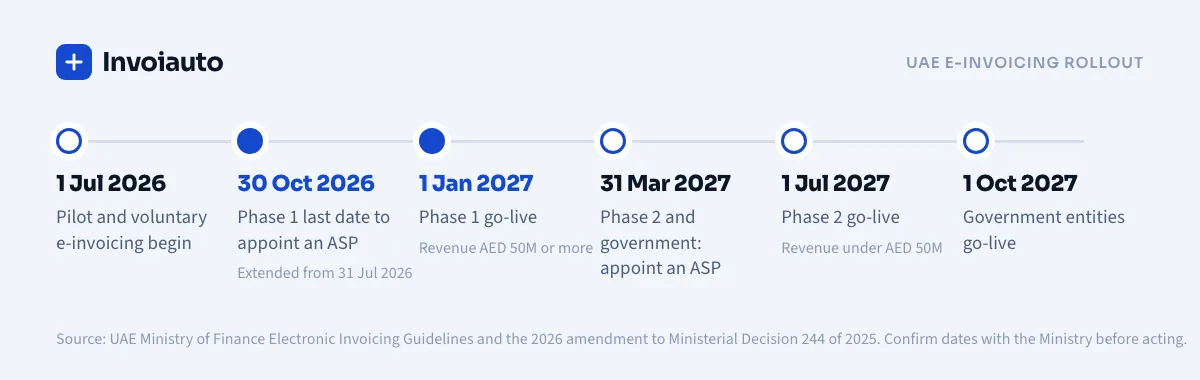
| Who | Last date to appoint an ASP | E-invoicing must be live |
|---|---|---|
| Businesses with annual revenue of AED 50 million or more (Phase 1) | 30 October 2026 | 1 January 2027 |
| Businesses with revenue under AED 50 million (Phase 2) | 31 March 2027 | 1 July 2027 |
| Government entities | 31 March 2027 | 1 October 2027 |
A pilot programme and voluntary e-invoicing have been open since 1 July 2026. Penalties for voluntary users apply only from the date they would be required to comply.
Does Phase 1 apply to your business?
The Ministry's Electronic Invoicing Guidelines set the scope in a few lines:
- It covers every person conducting business in the UAE, whether or not they are VAT registered.
- B2B, B2G, G2B and G2G transactions are in scope. Sales to consumers (B2C) are not.
- Transactions between members of the same VAT group are in scope, but they get a 24-month grace period starting 1 January 2027.
- A few specific exclusions exist, for example certain financial services and some airline services. Check the guidelines for the full list.
Which revenue figure the AED 50 million threshold uses, and for which period, is something to confirm with your tax adviser or the Ministry. Do not assume it matches the turnover figure on your VAT return.
What "appoint an ASP" actually involves
An ASP is the accredited provider that exchanges your invoices over the Peppol network and reports the tax data to the Federal Tax Authority. A few rules from the guidelines are worth knowing before you shortlist anyone:
- You appoint one ASP for both sending (sales) and receiving (purchases).
- You start the onboarding yourself through EmaraTax. The ASP does not start it for you.
- Your ASP gives you a Peppol participant identifier once you are onboarded.
- E-invoices are XML files in the PINT AE format. They do not carry a QR code or barcode, and a PDF on its own is not an e-invoice.
The Ministry publishes the list of accredited providers. Choose from that list, not from a vendor's own claim of being "approved".
An 8-step UAE e-invoicing Phase 1 checklist
1. Confirm your phase and scope
Check your revenue against the AED 50 million line, list every legal entity involved, and note which of your transactions are B2B or B2G. If you sell to both consumers and businesses through the same till or web shop, you will need a reliable way to tell the two apart, because only the business sales need an e-invoice.
2. Map every system that creates an invoice
Write down each system that produces an invoice or credit note: your ERP, a CRM that raises quotes and invoices, a billing tool, point-of-sale terminals, an online store, even spreadsheets. Note the owner, the entity, the invoice types and the monthly volume. Each system that issues invoices needs a route to your ASP, and the forgotten ones are the ones that cause trouble later.
3. Audit your invoice data
Structured invoices fail on messy data. Check that:
- your own Tax Registration Number (TRN) and legal name are correct for every entity;
- business customers have valid TRNs on file;
- tax codes are consistent from one system to the next;
- invoice numbers do not collide when two systems issue invoices;
- every credit note points back to the invoice it corrects.
Your ASP can tell you which fields its validation checks. For the full field rules, use the official PINT AE data dictionary.
4. Choose your ASP
Shortlist from the Ministry's accredited list and ask each provider:
- Which of your systems does it connect to directly, and what does it expect from the rest?
- What input formats does it accept: API, file upload, ERP connector?
- How are rejected invoices handled, and who is told?
- Where is data stored, and how do you retrieve five years of records?
- How long does onboarding take, and how is pricing tied to volume?
5. Decide how invoice data will reach the ASP
The guidelines list "agree on approach to transmit invoice data" as its own step. With one ERP this can be a single connector. With several systems it is a design decision: a connector per system, a custom export per system, or one data layer between all your systems and the ASP. Our guide to UAE e-invoicing integration for ERP, CRM, POS and Shopify compares the options.
6. Test end to end
Do not stop at "the connection works". Test a standard invoice, a credit note, an invoice with several tax categories, a zero-rated sale, a customer with and without a TRN, a rejected invoice that you correct and resend, and a busy day's volume. The voluntary phase exists so you can do this without penalty risk.
7. Plan the cutover
Not every customer will be onboarded on 1 January. The guidelines note that a buyer who has not implemented e-invoicing may still need a separate tax invoice or commercial invoice to recover input tax. Decide who sends that, who watches the rejection queue, and who your ASP calls when something fails.
8. Set up retention and ownership
Taxable persons must keep e-invoicing data for five years following the tax period it relates to, in a system that preserves integrity and lets the FTA retrieve records on request. Name one owner for the process, and make sure someone is responsible for telling your ASP about changes in your registered details.
Three UAE e-invoicing Phase 1 mistakes to avoid
- Treating the ASP appointment as the finish line. Appointing an ASP by 30 October meets one deadline. You still have to connect your systems, test and go live by 1 January.
- Generating PDFs and calling it done. The mandated format is structured XML. A nicer PDF template does not make an e-invoice.
- Leaving non-ERP systems until last. Online stores, point-of-sale systems and CRMs are often built by different teams and vendors. Start them in parallel with the ERP.
What happens if you miss the ASP deadline?
Under Cabinet Decision No. 106 of 2025, failing to implement e-invoicing or appoint an ASP on time carries a fine of AED 5,000 per month of delay or part of a month. Late invoices and unreported system failures carry separate fines. We break down every amount, with worked examples, in UAE e-invoicing penalties explained.
Frequently asked questions
Does the 30 October extension move the go-live date?
No. For UAE e-invoicing Phase 1, the extension changed only the date for appointing an ASP. Businesses must still be live on 1 January 2027.
Do I still need to issue a tax invoice?
Yes. E-invoicing does not remove the obligation to issue a tax invoice or tax credit note. It changes the form: for businesses in scope, the tax invoice must be issued as an electronic invoice.
Are B2C sales included?
No. Supplies to consumers are outside the scope for now. Sales to other businesses and to government are inside it.
Can I appoint more than one ASP?
No. A business in scope appoints one ASP for both sending and receiving invoices.
What format are UAE e-invoices in?
XML, following the Peppol PINT AE specification. They do not include a QR code or barcode.
Next step if your invoices come from several systems
Choosing an ASP solves where invoices go. It does not solve where the data comes from. If your invoices originate in more than one system, Invoiauto connects each source once, normalizes and validates the data against PINT AE, and delivers a clean feed to whichever ASP you choose.
