
UAE e-invoicing penalties are set by Cabinet Decision No. 106 of 2025, published by the Ministry of Finance in late 2025. The headline figure is AED 5,000 for every month, or part of a month, that a business is late in implementing e-invoicing or appointing an Accredited Service Provider (ASP). Late invoices, unreported system failures and unreported changes carry their own fines. This guide lists every amount, shows how they add up in practice, and explains what to put in place so you never see one.
Last updated 22 October 2026. The figures below come from the Ministry's announcement and advisory-firm summaries. Check the decision text in the official gazette before relying on them for a legal position.
UAE e-invoicing penalties at a glance
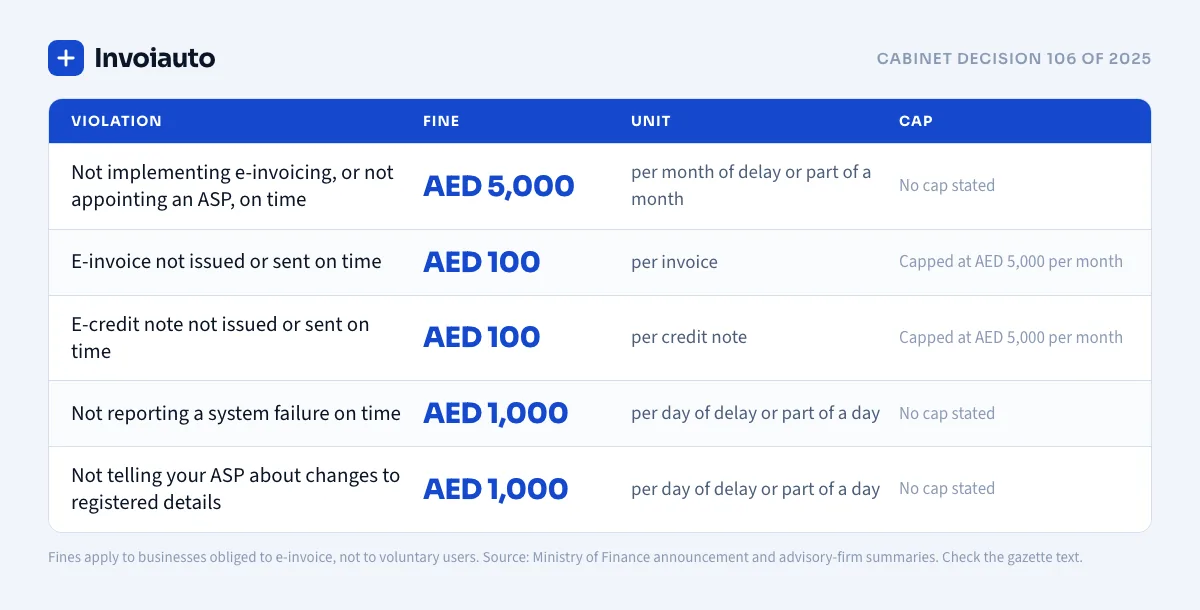
| Violation | Fine | Unit | Cap |
|---|---|---|---|
| Not implementing e-invoicing, or not appointing an ASP, on time | AED 5,000 | Per month of delay or part of a month | None stated |
| E-invoice not issued or sent on time | AED 100 | Per invoice | AED 5,000 per month |
| E-credit note not issued or sent on time | AED 100 | Per credit note | AED 5,000 per month |
| Not reporting a system failure on time | AED 1,000 | Per day of delay or part of a day | None stated |
| Not telling your ASP about changes to your registered details | AED 1,000 | Per day of delay or part of a day | None stated |
Who the UAE e-invoicing penalties apply to, and from when
The penalties apply to persons who are obliged to use the e-invoicing system. They do not apply to businesses that issue e-invoices voluntarily. The Ministry's Electronic Invoicing Guidelines say that for voluntary users, administrative penalties apply only from the date the business is required to implement e-invoicing.
For Phase 1 businesses, with annual revenue of AED 50 million or more, the ASP appointment deadline is 30 October 2026 and go-live is 1 January 2027. Phase 2 businesses appoint an ASP by 31 March 2027 and go live on 1 July 2027. Our UAE e-invoicing Phase 1 checklist covers the dates and the steps in detail.
Worked examples of UAE e-invoicing penalties
These are illustrations using the published amounts. They are not a prediction of how the authority will assess any specific case.
Appointing an ASP late
If a Phase 1 business appoints its ASP 20 days after the deadline, that is part of one month: AED 5,000. If it takes 65 days, three started months have passed: AED 15,000, assuming each started month counts.
Late invoices and credit notes
Suppose 120 e-invoices go out late in one month. At AED 100 each that would be AED 12,000, but the cap limits the fine for e-invoices to AED 5,000 for the month. If 15 credit notes were also late, the credit note fine is AED 1,500, because credit notes are listed as a separate violation with their own AED 5,000 cap.
An unreported failure
If your system or your ASP connection fails and you do not report it within the required time, each day or part of a day of delay is AED 1,000. Four days of delay is AED 4,000, and no cap is stated.
What the published figures do not tell you
- The summaries we reviewed do not say whether different fines can be combined for the same period. Ask your tax adviser.
- No monthly cap is stated for the AED 5,000 delay fine or the AED 1,000 daily fines.
- The time limits for issuing, sending and reporting are set in separate Ministry and FTA rules. Confirm the current ones with your ASP.
The fines are modest next to the operational risk. If your systems cannot issue valid e-invoices, you cannot bill your customers in the normal way, and that costs far more than AED 100 per invoice.
How to avoid UAE e-invoicing penalties
| Penalty | What prevents it |
|---|---|
| Late implementation or ASP appointment | Pick an ASP from the Ministry's accredited list, start onboarding through EmaraTax early, and keep a dated project plan with an owner |
| Late invoices and credit notes | Clean master data, tested connections from every source system, and a daily check of rejected or stuck invoices |
| Unreported failures | A written runbook: who decides an outage is reportable, who reports it, and how fast. Make sure your ASP's outage notices reach that person |
| Unreported changes | A change checklist for new entities, mergers, VAT group changes and changes of registered details, with a step to notify the ASP |
Late invoices usually come from data problems or broken connections, not from the ASP. If your invoices come from several systems, our guide to UAE e-invoicing integration for ERP, CRM, POS and Shopify shows where the failures tend to start.
Frequently asked questions
Do the fines apply during the pilot or voluntary phase?
No. Voluntary users are not subject to these penalties, and for them penalties start only when they become obliged to comply.
Is the AED 100 fine capped?
Yes. The fine for late e-invoices is capped at AED 5,000 per month, and the fine for late credit notes has its own AED 5,000 monthly cap.
Are consumer sales affected?
Sales to consumers are outside the e-invoicing scope for now, so there is no e-invoice obligation, and no e-invoicing fine, for them.
What is the most expensive mistake?
The delay fine grows every month and has no stated cap, so appointing an ASP late is the one that keeps costing. Failing to report a system failure can also build up daily.
Get ahead of the deadline
Most penalties start with data that is not ready or a source system that is not connected. Invoiauto validates invoices from all your systems before they reach your ASP, and gives you a status trail for every invoice so nothing sits unnoticed.
Sources
- Forvis Mazars: Understanding Cabinet Decision No. 106 of 2025 on e-invoicing violations
- ClearTax: e-invoicing penalties under Cabinet Decision 106/2025
- UAE Ministry of Finance: Electronic Invoicing Guidelines v1.0 (23 February 2026)
- Deloitte Middle East: ASP appointment deadline extended, go-live remains 1 January 2027
